Joint Economic Forecast Autumn 2026: Recovery Under Structural Stress – Fiscal Policy on Slippery Ground
The German economy has been on an upturn since the end of 2025. Following several years of economic weakness, economic output has risen at an accelerated pace over the past three quarters and is now back for the first time above the level reached in the course of 2022 before the onset of the gas price crisis at that time. There was a surprisingly strong rise in exports and value added in the manufacturing sector, in particular. However, corporate investment and private consumption remained weak, with the energy price shock triggered by the Iran war having a dampening effect.
In the third quarter, the recovery slowed temporarily. Although sentiment indicators have continued to brighten, the hard indicators paint a weaker picture for the current period: Industrial production declined noticeably in July, and goods exports have recently been declining slightly. The ongoing period of low waterway levels since mid-July is particularly hampering the chemical industry. Added to this are losses in purchasing power resulting from higher energy prices, an aspect that is weighing in particular on consumer-related services.
Starting in the fourth quarter, the recovery is expected to gain momentum again, supported by expansionary fiscal policy and in view of a robust global economy. As water levels return to normal, transport-related obstacles to production in the manufacturing sector should also ease, and some of the deferred production should be made up. The recovery is expected to continue in 2027 and be driven primarily by domestic demand. The expansion is likely to slow down in 2028. Fiscal policy will then be slightly restrictive.
Compared to earlier times, the upturn remains unusually weak. The key factor here is the continuing decline in potential growth due to demographic trends. The labor force potential is shrinking; this is already reflected in the drop in employment that has been seen in about the last year and a half.
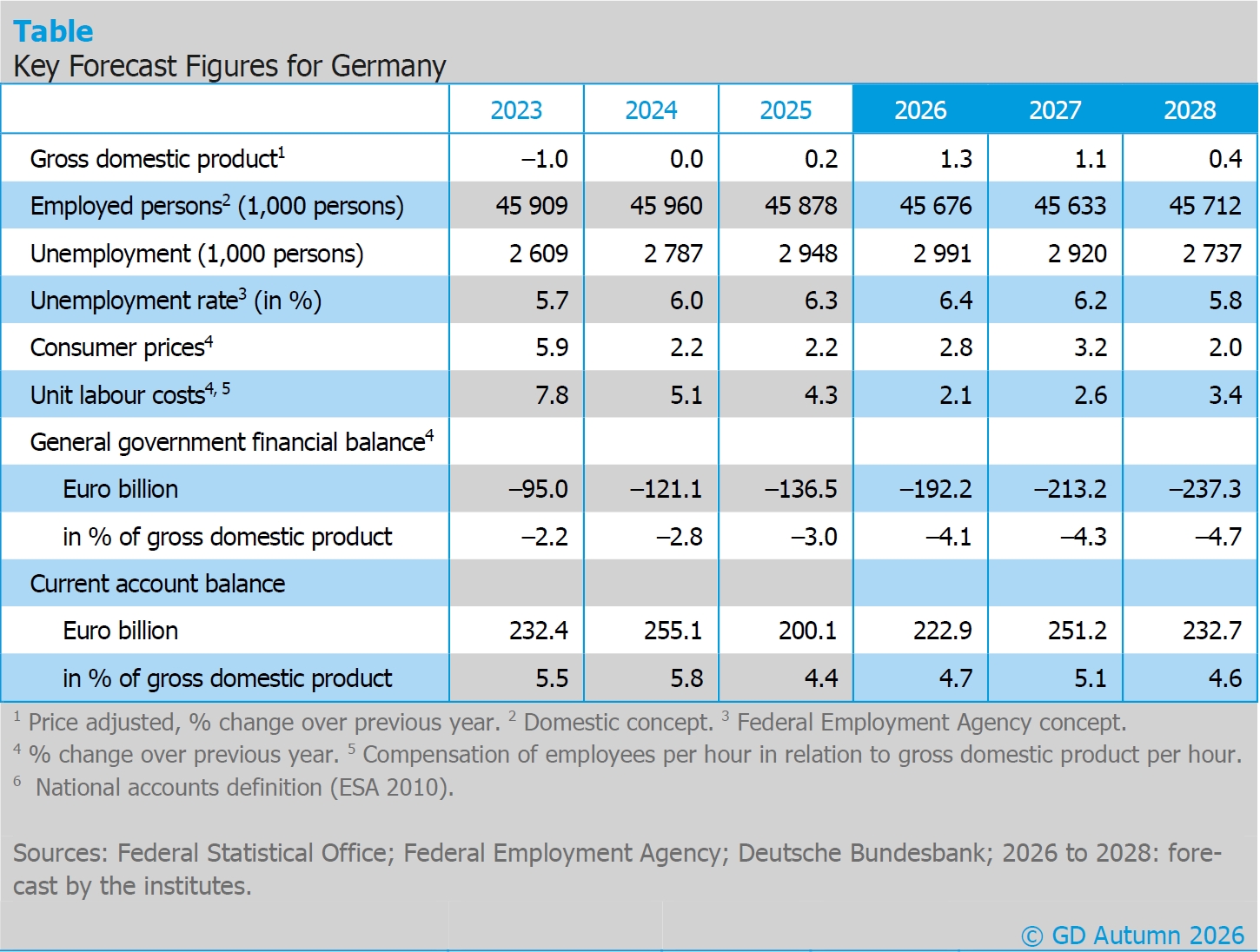
All in all, price-adjusted gross domestic product is expected to grow by 1.3% this year. For 2027 and 2028, the institutes anticipate growth of 1.1% and 0.4%, respectively. Compared to the spring report, the institutes are thus raising their forecast by 0.7 percentage points for this year and 0.2 percentage points for next year. The 68% prediction intervals based on historical forecast errors from the Joint Economic Forecast Project Group range from 1.1% to 1.5% in 2026 and from –0.6% to 2.8% in 2027.
Consumer prices are expected to rise by 2.8% this year and by 3.2% next year; the inflation rate is projected to fall to 2.0% in 2028. The recovery is only reaching the labor market with a delay. Employment will probably fall significantly on average in 2026 and decline slightly once more in 2027, before rising again in 2028. The unemployment rate is expected to be 6.4% this year and to fall to 6.2% and 5.8%, respectively, in the following two years. As a percentage of gross domestic product, the government’s financing deficit will rise from 4.1% this year to 4.7% in 2028.
Global Economy
In the fall of 2026, the global economy continues to gain momentum. The strong expansion of artificial intelligence (AI) is giving a powerful boost to overall economic production, particularly in the United States and Asia. In many countries, a rise in defense spending is also bolstering demand. However, the energy price shock resulting from the military conflicts in the Gulf region has hindered a stronger expansion in production. The latest escalation has caused energy prices, and thus global economic risks, to rise significantly again.
Global industrial production is being spurred by the expansion of computing capacity for artificial intelligence and the associated energy infrastructure, particularly in the United States and China. The increase was especially strong in the first half of the year in Asia’s advanced economies, where Taiwan and South Korea are particularly closely integrated into the value chains relevant to AI technology.
Although the effects of the Gulf conflict on global industrial production are clearly visible, they have remained largely confined to the countries of the Gulf region: In the Middle East and Africa, it fell by more than a quarter when the war broke out in March, while industrial production remained stable in the other emerging economies and even tended to rise at an accelerated pace in the advanced economies.
Since the spring, consumer price trends have been largely impacted by energy prices. The core inflation rate (excluding energy and food) remained relatively stable. There are therefore currently no signs that the inflationary pressure fueled by energy prices is spilling over into other price trends.
The tailwinds for the global economy stemming from the spread of artificial intelligence remain intact for the time being. For instance, investment demand will probably continue to be driven by the need for additional data processing capacities and high spending on research and development. In addition, the high electricity demand associated with AI applications requires substantial investments in generation and grids. There is also stimulus from the financial markets, where price gains by the companies involved, if they are listed, are driving market developments and generating increases in wealth, which in turn are strengthening private consumption. However, the growth in AI investments is likely to slow gradually over the forecast period. Capacity bottlenecks in the production of capital goods are already evident and have led to considerable price increases.
Although the reduced availability of crude oil and liquefied natural gas, accompanied by corresponding price increases, is still a drag on global economic activity for the time being, these dampening effects are gradually subsiding. From a global economic perspective, the negative effects of rising energy prices are also mitigated by the fact that there are winners in this trend: countries and companies whose financial situation is improving and who, as a result, generate additional demand. The energy price shock is unlikely to bring about a lasting change in the inflationary environment, which means it is probably not necessary for monetary policy countermeasures to be taken on a larger scale than assumed in the forecast.
Global production is projected to grow at a rate of 2.6% this year, slightly more weakly than last year (2.8%). For 2027 and 2028, the institutes expect a slightly slower pace of expansion of 2.5%. Global trade in goods and services will likely increase by 5.3%. For 2027 and 2028, the institutes expect growth of 3.0% and 2.8%, respectively.
The boom in artificial intelligence harbors economic risks. Although there are currently no signs that the euphoria is coming to an end, it is quite possible that the profit expectations underlying the investments and company valuations will be disappointed. In this case, there could be a drastic revaluation of companies, which might appreciably slow down the economy through restricted investment and wealth effects. The risks from energy prices are also significant. As long as transport routes for crude oil from the Gulf region remain massively disrupted, there will continue to be a considerable supply shortfall in the crude oil market. Long-term interest rates also pose a risk. If they remain high for a lengthy period or even rise further, there is the threat that the burden on state budgets from servicing debt will increase strongly. However, corporate investment could also be significantly dampened by a further rise in real interest rates.
German Economy
The German economy has been on an upturn since the end of 2025. Following several years of economic weakness, economic output has risen at an accelerated pace over the past three quarters and is now back for the first time above the level reached in the course of 2022 before the onset of the gas price crisis at that time. Supported by expansionary fiscal policy and in view of a robust global economy, the recovery is likely to continue in general, even if high energy prices act as a drag. In the third quarter, however, economic momentum will be temporarily hampered by the low levels of major waterways; thereafter, overall economic production is expected to pick up again.
In the first half of 2026 , the German economy was far more buoyant than anticipated in the spring. There was a surprisingly strong rise in exports and value added in the manufacturing sector, in particular. The global AI boom provided a boost. Another factor was that competitors in the Gulf region faced significant impediments to production. Government consumption also rose strongly. However, corporate investment and private consumption remained weak, with the energy price shock triggered by the Iran war having a dampening effect. While prices for fuels and heating oil increased sharply, those for other goods have shown little response so far.
In the third quarter, the recovery slowed temporarily. Sentiment indicators have continued to brighten; for instance, the ifo Business Climate rose several times in a row recently and, with the global economy remaining robust, export expectations and incoming orders also indicate that the recovery will continue. However, the hard indicators paint a weaker picture for the current period: Industrial production declined noticeably in July, and goods exports have recently been declining slightly. The ongoing period of low waterway levels since mid-July is particularly hampering the chemical industry. Added to this are losses in purchasing power resulting from higher energy prices, an aspect that is weighing in particular on consumer-related services. Overall, price-adjusted gross domestic product is likely to have increased only slightly, by 0.1%, in the third quarter compared with the previous quarter.
Starting in the fourth quarter, the recovery is expected to gain momentum again. As water levels return to normal, transport-related obstacles to production in the manufacturing sector should ease, and some of the deferred production should be made up. At the same time, the robust economy in the rest of the world, particularly in European sales markets, will probably bolster exports further. In Germany, expansionary fiscal policy measures are increasingly gaining traction: Higher spending on defense and infrastructure is reflected primarily in public investment and purchases of intermediate goods. There are also stimuli from business-related services. Not least, the German economy is benefiting from the global AI boom, for example through the export of data processing equipment, the construction of data centers, and services in the information and communications sector. Given moderate growth in real disposable incomes, private consumption is also expected to pick up slightly again. Overall, these factors indicate that the upturn will continue over the remainder of the forecast period following the temporary dip in the third quarter.
The more favorable economic picture stands in some contrast to the improved, yet still subdued, sentiment. The summer revision of the national accounts has raised the level of economic output, suggesting that the recession of 2023 and 2024 was milder than previously reported. However, consumers in particular are skeptical about the economic situation, and many companies remain cautious in their assessment of the business situation. This restraint is particularly evident as regards corporate investment, and residential construction has also not yet picked up, despite rising numbers of permits. The willingness to invest remains low due to unfavorable location conditions and was also dampened recently by higher financing costs. While there is a strong increase in public spending on infrastructure and defense, there is on the other hand continued weak private investment activity, especially since there are no signs of fundamental structural reforms that could, for example, significantly limit the rise in social security contributions due to demographic factors and improve the propensity of companies to invest.
The recovery is expected to continue in 2027 and be driven primarily by domestic demand. Private consumption will rise moderately in line with real disposable incomes. The increase in building permits is likely to result gradually in higher investment in residential construction, and investments in intellectual property will probably continue to grow in line with their long-term trend. Public spending on defense and infrastructure will rise again, even as the fiscal stimulus diminishes significantly overall. The expansion will weaken further in 2028. Fiscal policy will then be slightly restrictive.
Compared to earlier times, the upturn remains unusually weak. The key factor here is the continuing decline in potential growth due to demographic trends. It is slightly higher than what was estimated in the spring, also due to the statistical revision. However, this is largely attributable to changes in methodology. The picture of declining growth drivers persists. The labor force potential is shrinking; this is already reflected in the drop in employment that has been seen in about the last year and a half. The production gap is currently still negative, but is expected to close over the forecast period. In the future, even low rates of growth in gross domestic product will then be sufficient to ensure that overall economic capacities are fully utilized.
All in all, price-adjusted gross domestic product is expected to grow by 1.3% this year. For 2027 and 2028, the institutes anticipate growth of 1.1% and 0.4%, respectively. Compared to the spring report, the institutes are thus raising their forecast by 0.7 percentage points for this year and 0.2 percentage points for next year. The higher number of working days will increase the average annual growth rates in 2026 and 2027 by 0.3 and 0.1 percentage points, respectively; in 2028, the lower number of working days will reduce the growth rate by 0.2 percentage points. The 68% prediction intervals based on historical forecast errors from the Joint Economic Forecast Project Group range from 1.1% to 1.5% in 2026 and from –0.6% to 2.8% in 2027.
Consumer prices are expected to rise by 2.8% this year and by 3.2% next year; the inflation rate is projected to fall to 2.0% in 2028.
The recovery is only reaching the labor market with a delay. Employment will probably fall significantly on average in 2026 and decline slightly once more in 2027, before rising again in 2028. The unemployment rate is expected to be 6.4% this year and to fall to 6.2% and 5.8%, respectively, in the following two years.

Rising Government Debt
As a percentage of gross domestic product, the government’s financing deficit will rise from 4.1% this year to 4.7% in 2028. Since the most recent reform, the path for government spending set out in the medium-term fiscal-structural plan has been the key controlling element in European budgetary monitoring. Between 2025 and 2028, the cumulative growth in net primary expenditures in Germany is expected to be 18.6%, well above the envisaged increase of 13.3%.
In many advanced economies, public debt ratios have trended upward since the financial crisis. In some countries, such as the United States and France, current public deficits exceed 5%. Consequently, concerns are growing in many places that a sovereign debt crisis could arise, with considerable consequences for the real economy. Yields on government bonds have also risen significantly lately. In Germany, the government debt ratio in 2025 (62.7%) is so far well below a level that would indicate that the sustainability of public finances is in jeopardy. However, since the financial constitution was amended in 2025, the debt brake no longer ensures the long-term stability of public finances.
The institutions prepare a projection of gross debt based on the available medium-term projection (using the EU method). This assumes that the scope for debt provided by the national debt brake will be fully utilized with respect to the core budgets of the federal government and the states, as well as the Special Fund for Infrastructure and Climate Neutrality (SVIK). This will require considerable consolidation measures starting in 2029 to reduce the primary deficit. Even assuming that the growth rate in defense spending weakens as it approaches the NATO benchmark relative to gross domestic product, and that the national debt brake is adhered to, the debt ratio is also likely to continue rising during the medium-term projection period (2029 to 2031). Among other things, this implies that government interest payments will rise to just under 2% of gross domestic product. Before the shift in fiscal policy initiated in 2022 with the Special Fund for the German Armed Forces, it stood at ¾%. Furthermore, once the National Escape Clause expires, tensions are likely to arise between Germany’s fiscal planning and EU regulations under the medium-term fiscal-structural plan.
You Might Also be Interested in
Contact
